Musician, Actor, Dancer
Anatomy of the Artist
Illustrated book, 265 pages.
Marc Papillon Éditions – 2024

Preamble

Reading this book is like setting out on a journey through the acts, crossing time and the ages, discovering a new theme on every page. The aim is not to provide a detailed analysis of each theme, but rather to present a panorama, a collection of subjects that allows artists to juggle consciously with the many facets of their art and their being.
Each page is designed to stimulate reflection, encourage personal exploration and help readers understand how body and mind interact in the creative process.
The book

Musicians, actors and dancers work with the same tools: a body, a breath, attention, emotions. Their forms of expression differ, but they share a common language. Anatomy of the Artist is written for all three.
The book follows an artist’s life in seven acts, from early childhood to old age, and explores more than a hundred themes, illustrated with the author’s photographs. It serves as the introduction to the Anatomy of the Musician series.
Why so many themes?
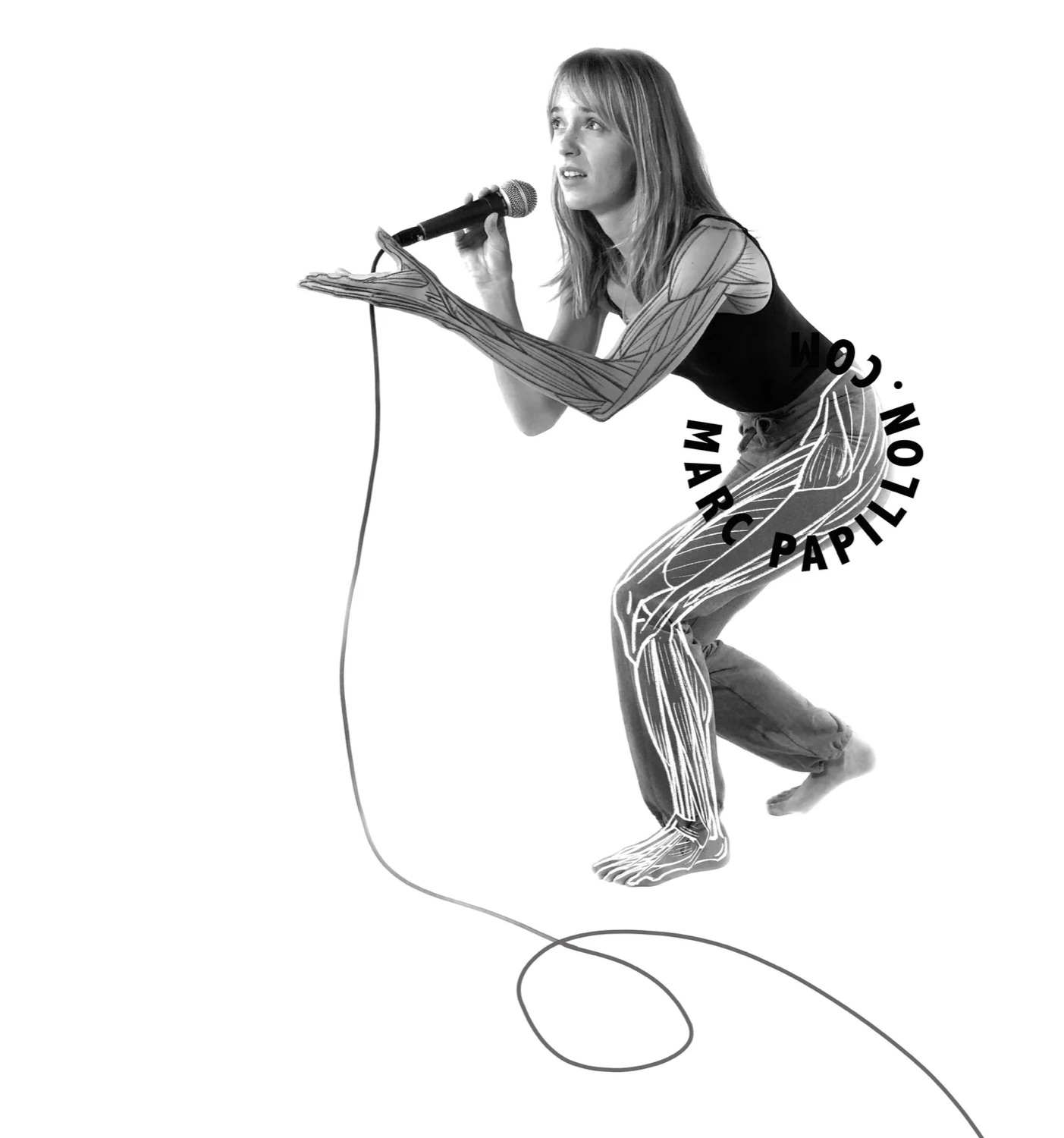
A musician devotes most of their work to the instrument, the repertoire, the difficult passages. Yet what shapes their playing reaches far beyond that frame: how they sleep, recover, breathe and sit, their relationship to mistakes and criticism, the confidence built or damaged in childhood, the upheavals of adolescence, the balance between personal and professional life, the way they grow older alongside their art.
These themes are fundamental, yet they are rarely addressed consciously. Instrumental lessons leave them little room, and musicians usually live through them without ever naming them. Still, they are constantly at work in the background, on technique as much as on the pleasure of playing.
The book does not claim to treat each of them in depth. It offers a panorama: each page opens a door, sets out a few landmarks and invites readers to recognize what, in their own path, deserves a closer look. By multiplying the angles, one comes to perceive how body, mind and heart work together in the artistic gesture.
Book plan
A preamble and seven acts

Preamble
Rethinking confidence · Developing, acting and connecting · Mobile stability · The logical spiral of learning and research · Anatomy in the service of autonomy · Discipline · Patience · An artist’s challenges · Having fun means playing better · A mental approach to art · The right to make mistakes · Musical nuances · Hyperlaxity and anxiety · Felt bodily rhythm · The paradox of hyperadaptability and inflexibility · Mastering the body as a whole · Skills · Instability · The artist’s embodied cognition
Act I · Early childhood
Important, not serious · Talent and mythology · Fetal development · Psychomotor development · Sensory exploration · Discovering the body · Walking · First emotions tied to music · Listening to music · Learning musical language · Siblings and discoveries · Learning to sing · Learning to dance · A young musician’s brain
Act II · Childhood
Brain plasticity · Creativity · Daring to disappoint · Stage fright and anxiety · Self-criticism · The criticized child · Consistency and regularity · Time management · Tolerance: the freedom to err early · Finding your voice · Giftedness · The pursuit of performance · Destructive competition · Collective improvisation · Learning active listening · Warming up and stretching · First steps in improvisation · Functional anatomy and teaching · Divergence and convergence · Artistic research · Instrumental technique · Improvisation · Musician – Actor – Dancer – Stage director
Act III · Adolescence
Hormones · Adolescence and emancipation · Parental support · Growth · Confidence versus self-esteem · Confidence · Stature and confidence · Esteem · Managing stress · Crossing disciplines · Discovering forms of artistic expression · Ambitious stage projects · Outside pressures · Physical activity · Continuing education, inspirations and influences · Living in the imperfect · Entering professional life · The need for support · Building an identity · Addiction
Act IV · Young adulthood
No pain, you gain! · A deep desire to improve · Developing new skills · Balancing personal and professional life · Autonomy – Stimulation – Evolution · Looking after your health · Stage performance · Behavioral posture · Building strong social ties · Nutrition · Breathing · Sitting well · Assurance and esteem · Patience and perseverance without overdoing it · Passing it on · Between control and sensitivity
Act V · Adulthood
Collaborative projects and self-acceptance · Beyond failure and success · Social involvement · Sleep quality · Dynamic meditation · Dynamic recovery · Concentration and performance · Goals and motivation · Visualization and positive thinking · Passing on know-how
Act VI · Early senior years
Inspiration and imitation · Enjoying · Wisdom and detachment · Between pressure and inspiration · Enjoying still · Growth and recognition · Memory, art and identity · Constructive impatience
Act VII · Senior years
Time management · Today will be my day, all I have to do is play · Taking time to feel · Play like a child · A positive attitude for artists · Happy for no reason, like a child · Beyond norms · MAD – Musicians, Actors, Dancers · Creative love · New artists · The uncertainty of knowledge · The essence of musical learning · Taking time · Intelligence and learning · Being yourself, flaws and all
Foreword
Solal Comparini, violin and equestrian art
Equestrian art and music: two worlds that seem very far apart.
On one side, equestrian work, which engages the rider’s whole body, together with the knowledge, mastery and respect of a second body, that of the horse.
The passionate rider devotes themselves entirely to their equine partner, during training and schooling sessions but also in the demanding daily routine of looking after and caring for the horse, creating a unique bond.
On the other side, there is music. For my part, I chose strings: the viola, then the violin, instruments with undeniable emotional power, which call on the joints over a few millimeters that are essential to creating music that is in tune and expressive. We find ourselves alone with our expectations and our limits, often with a static body that has to resign itself to repeating for hours, sometimes to the point of triggering functional disorders.
At the time, I was 16 and refused to choose between equestrian art and the violin. However, the intensity of the physical work, the hours spent on horseback whatever the weather, the technical and repetitive work on the violin… Despite incredible mentors, the lack of deep awareness of my own body ended up hampering my playing, with yet another bout of tendinitis forcing me to rest.
In my advanced cycle at the conservatory, my body began to suffer from all the demands I was placing on it, a mix of physical and mental tension. It was thanks to this period of questioning that I was lucky enough to start working with Marc Papillon at the Musicians’ Clinic in Paris.
His passion for optimizing movement and for putting the musician’s enjoyment first changed my life almost 15 years ago. His knowledge and the way he passes it on allowed me to tame my limits and then push them beyond what seemed possible. His vision perfectly complemented my work at the conservatory, and on horseback.
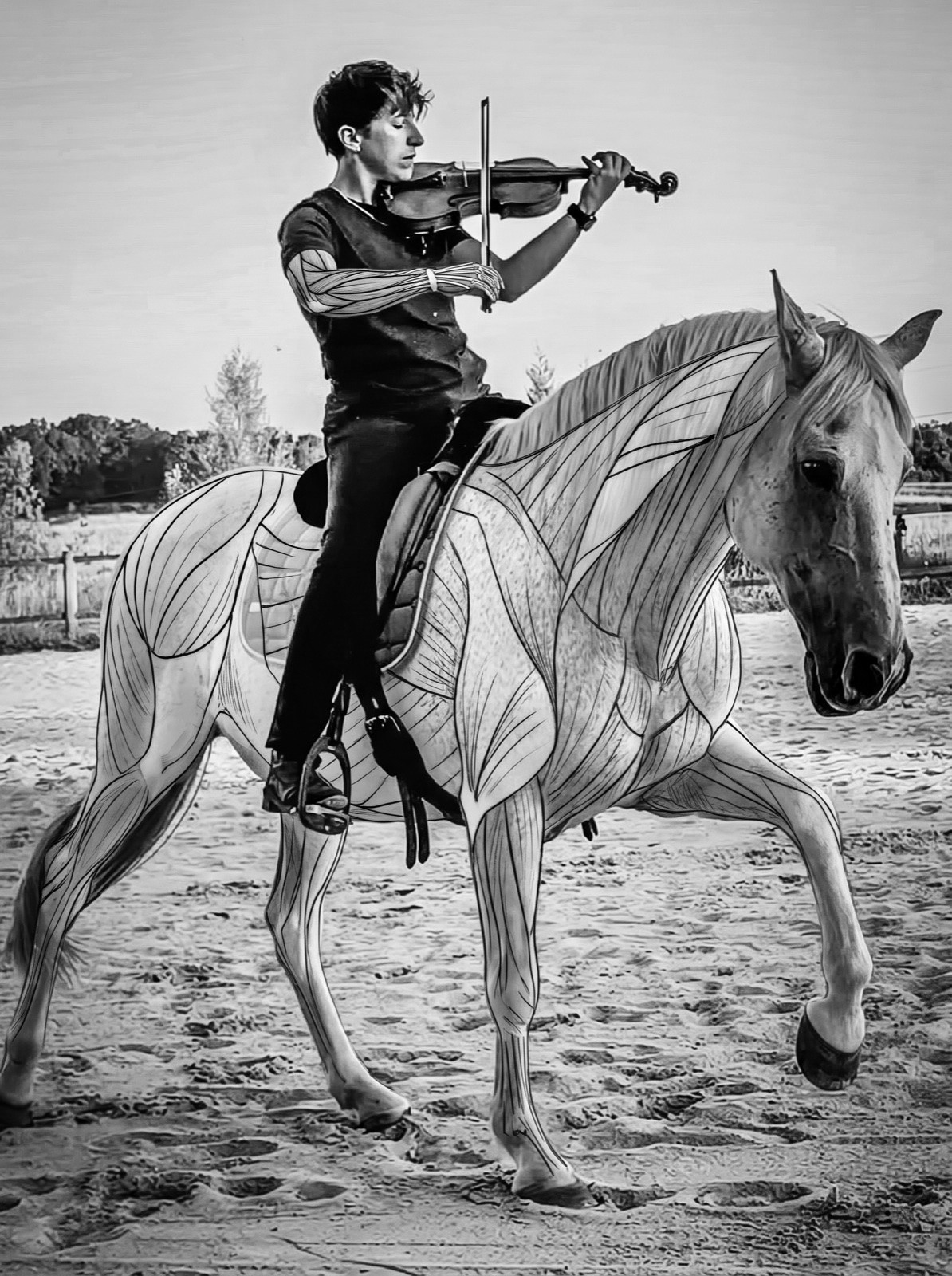
I learned to know my body and to make it my teammate in adventure, so that I could play my violin on my horse at liberty, in performance.
In cooperation with Marc Papillon, I pushed the independence of the aids to the extreme, with enjoyment, muscle tone and ease:
My body from the navel to the toes is devoted to my horse: control of my body weight, the movement of my legs, the orientation of my coccyx and my breathing all carry different meanings for my horse, who is completely at liberty. Only my voice occasionally adds to the guidance.
The upper part of my body must remain supple and stable, so that I can play with my bow and make the strings of my violin vibrate without squeezing the neck with my left hand, which must stay free to link the notes, and while keeping my neck free of any contraction that would make harmony impossible. A balanced symbiosis can then settle between the upper and lower parts of my body.
Then all that remains is for my horse Ti Amo and me to let ourselves go and create a unique, emotional and artistic moment in front of the audience.
Thank you, Marc, for helping me make this dream come true!
To you who are reading these lines: I hope you will find in this book the inspiration to push your physical and mental limits with awareness and enjoyment!
Solal Comparini
Order the book
Anatomy of the Artist
Illustrated book, 265 pages.
Marc Papillon Éditions – 2024