Anatomy of the Musician · Technique and Performance
Harps
Illustrated book, 252 pages.
Marc Papillon Éditions – 2023

The book
It all starts with an idea. Perhaps you want to join an existing band or start a new ensemble? Perhaps you want to take your playing to a whole new level?
Take a fresh look at each of the systems involved, so that you can then use them together with ease!
Visualize and feel more clearly

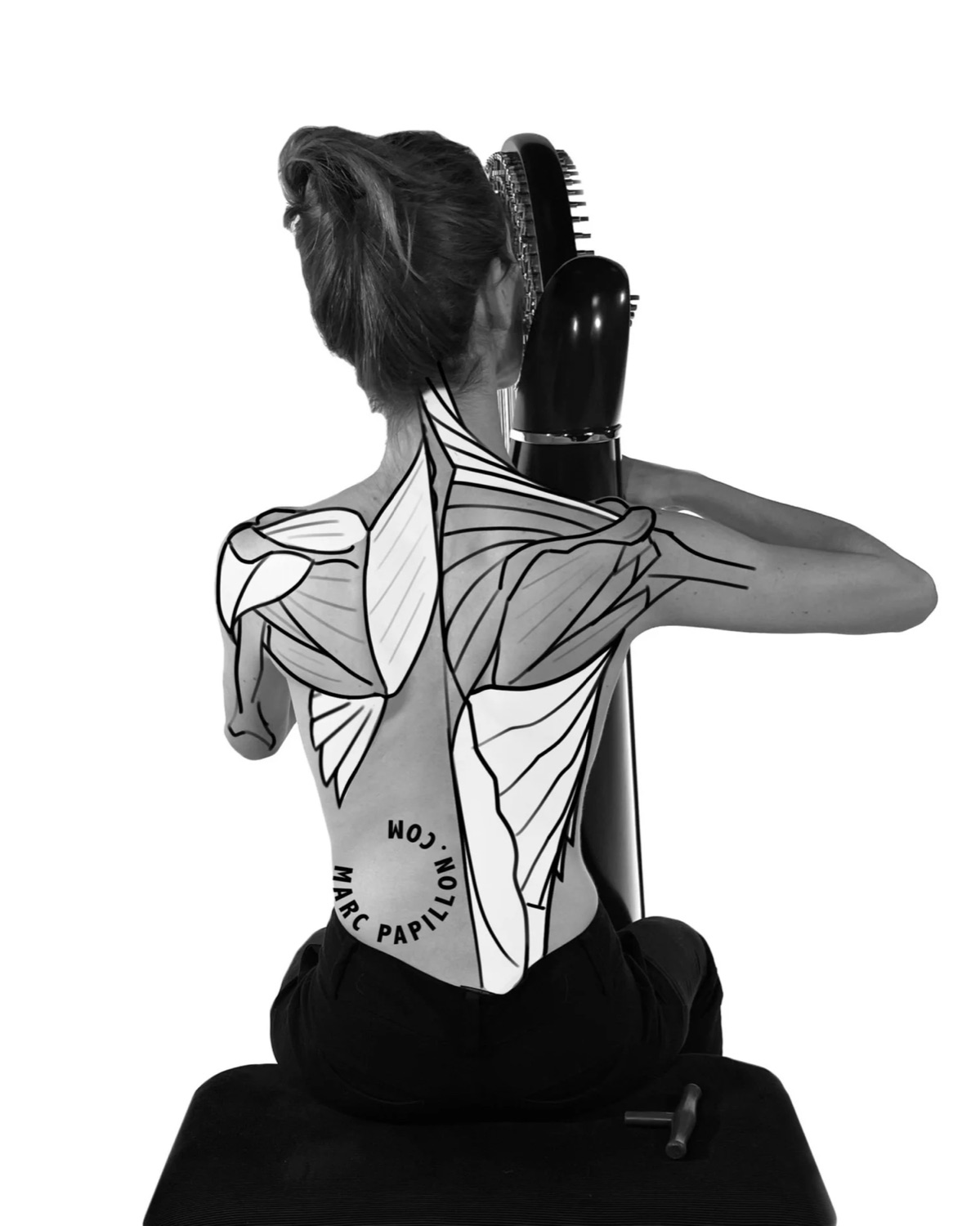
Functional anatomy at the heart of your technique, in the service of music!
Foreword by Chloé Ducray
Harpist
To all harpists who delight in continuing to understand, to learn and to feel,
this book is for you!
Part of a large collection devoted to optimizing musicians’ playing, it draws on its author’s long experience and on the reflections that shaped my training with Marc. Comprehensive as it is, it will go on living and improving as it passes from hand to hand and from musician to musician!
Through these pages, Marc Papillon offers you a connection with the body, with its magnificent workings and with the instrumental challenges that arise from them. The book is a precious well of information that will give you the keys to refine your playing and surpass yourself. Because yes, there truly is a before and an after with this kind of reading and this kind of encounter: a revelation of what each of us is capable of.
Chloé Ducray
Toned and relaxed

Proprioception is defined as the individual’s ability to know the position of their body in space, or of each finger relative to the others, and to assess the resistance against which a motor task is performed. More precisely, proprioception has three properties: 1/ position sense, which continuously informs the individual of the angle at each joint, and therefore of the position of the limbs relative to one another and to the body; 2/ movement sense (kinesthesia), which corresponds to a sensation of speed, amplitude and direction all at once; 3/ force sense. Proprioceptive sensation arises from the stimulation of various receptors located throughout the musician’s body: visual, cutaneous, muscular, tendinous, articular and vestibular receptors. For example, during a particularly delicate passage, the movement is so fast that vision no longer provides the musician with any information. To locate the independent fingers in space and gauge their movements, the musician will therefore rely on proprioception…
Order the book
Anatomy of the Musician
Illustrated book, 252 pages.
Marc Papillon Éditions – 2023