An original edition · A pedagogy of the body in music
The Living Gesture
Learn, play, last
A 307-page book.
French edition · Marc Papillon Éditions – 2026
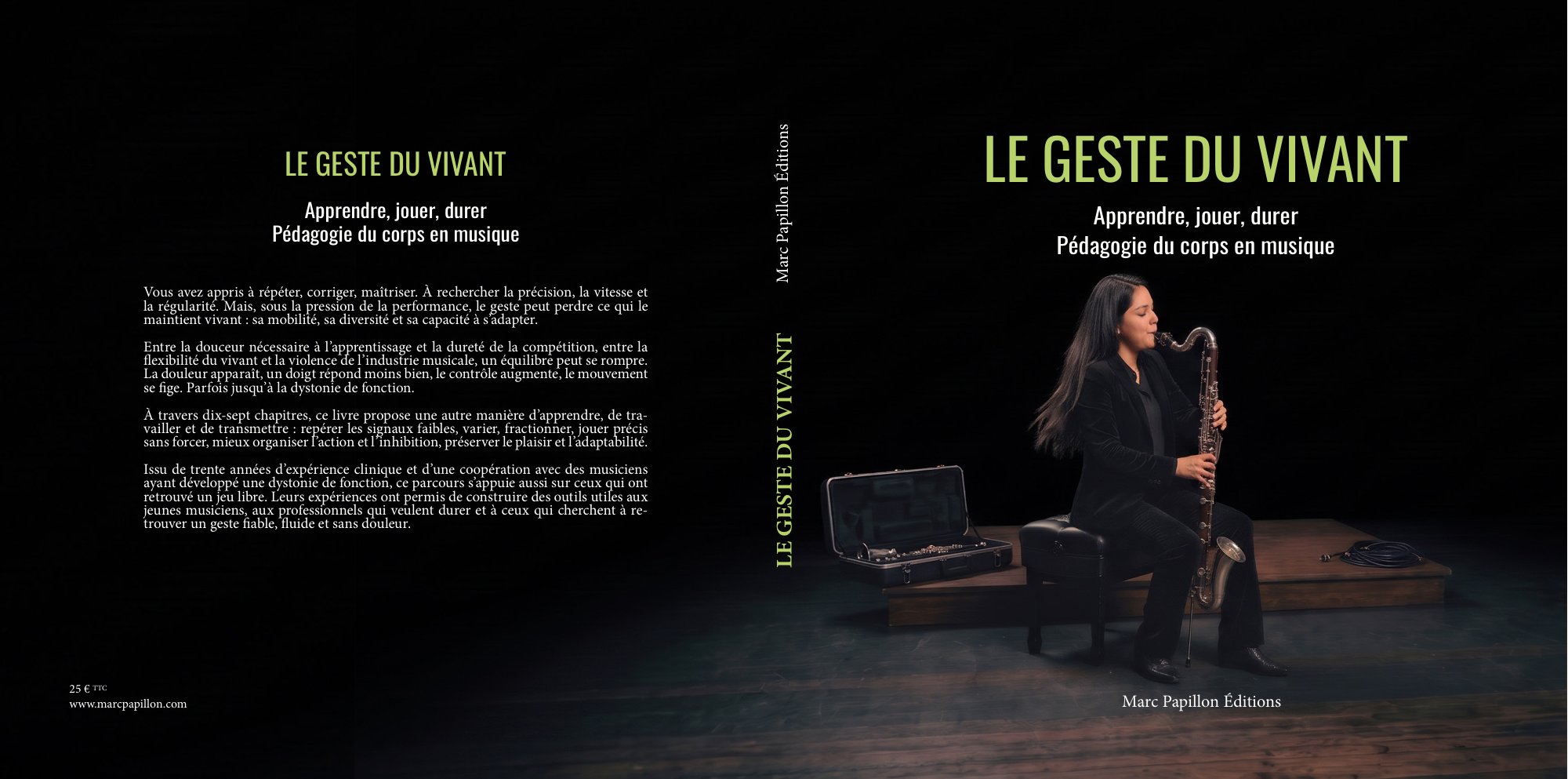
The book
Back cover
You learned to repeat, to correct, to master. To strive for precision, speed and consistency. But under the pressure of performance, a gesture can lose what keeps it alive: its mobility, its diversity and its capacity to adapt.
Between the gentleness that learning requires and the harshness of competition, between the flexibility of living things and the violence of the music industry, a balance can break. Pain appears, a finger responds less readily, control tightens, movement freezes. Sometimes all the way to focal dystonia.
Across seventeen chapters, this book offers another way to learn, to practice and to pass on: noticing faint warning signs, varying, breaking things down, playing precisely without forcing, better organizing action and inhibition, preserving pleasure and adaptability.
Drawn from thirty years of clinical experience and from cooperation with musicians who developed focal dystonia, this path also draws on those who regained free playing. Their experiences made it possible to build tools for young musicians, for professionals who want to last, and for anyone seeking to recover a reliable, fluid, pain-free gesture.
Excerpt
Foreword
For nearly thirty years, I have worked with musicians — beginners, students, professionals and seasoned performers — from very different repertoires and worlds. Some want to refine a gesture or transform their sound; others are preparing for an important event, hope to regain greater ease, or want to understand why a passage that once felt natural suddenly resists them. Many also come simply because they have understood that their body is their first instrument and that, as such, it deserves particular attention.
A musical gesture that can last does not depend on repetition or determination alone. It is built in the relationship between what musicians hear, what their body organizes, the way they inhabit time and the quality of attention they bring to what they are doing. When these dimensions work together, the gesture finds a kind of self-evidence: the body feels available, the instrument responds, and the musical intention can flow with relatively little effort.
Prevention does not mean living in fear of injury or constantly monitoring one’s body. It is rather a matter of learning to recognize the conditions in which one functions well, and knowing how to preserve them as workload, artistic demands or life circumstances change.
Building a foundation does not mean limiting the freedom to explore. On the contrary, it is what allows us to keep exploring for a long time, to let our playing evolve without losing what makes it alive and, year after year, to still be able to learn, play and last.
Part I
Cognition and central control
1. Observe to prevent
2. Repeat without repeating yourself
3. Inhibit to refine
4. Sound before gesture
5. Break it down to consolidate
6. Reorganize before playing again
Part II
The body and the instrument
7. Embodied rhythm
8. Tuning the instrument to the body
9. Stabilize to set free
10. Selective slowness
11. Balancing the embouchure
12. Pace yourself to last
Part III
Emotion and the senses
13. Embracing mistakes
14. Celebrating progress
15. Slowing down
16. Valuing robustness
17. Enjoy and share
Also inside
Epilogue: Staying alive in the gesture
The seventeen pillars
Glossary
References
Order the book
The Living Gesture
A 307-page book.
French edition · Marc Papillon Éditions – 2026