An original edition · Auditions, the embodied musician’s lab
Visualize & Feel
The musician’s body, an instrument of perception
A 121-page book.
French edition · Marc Papillon Éditions – 2026
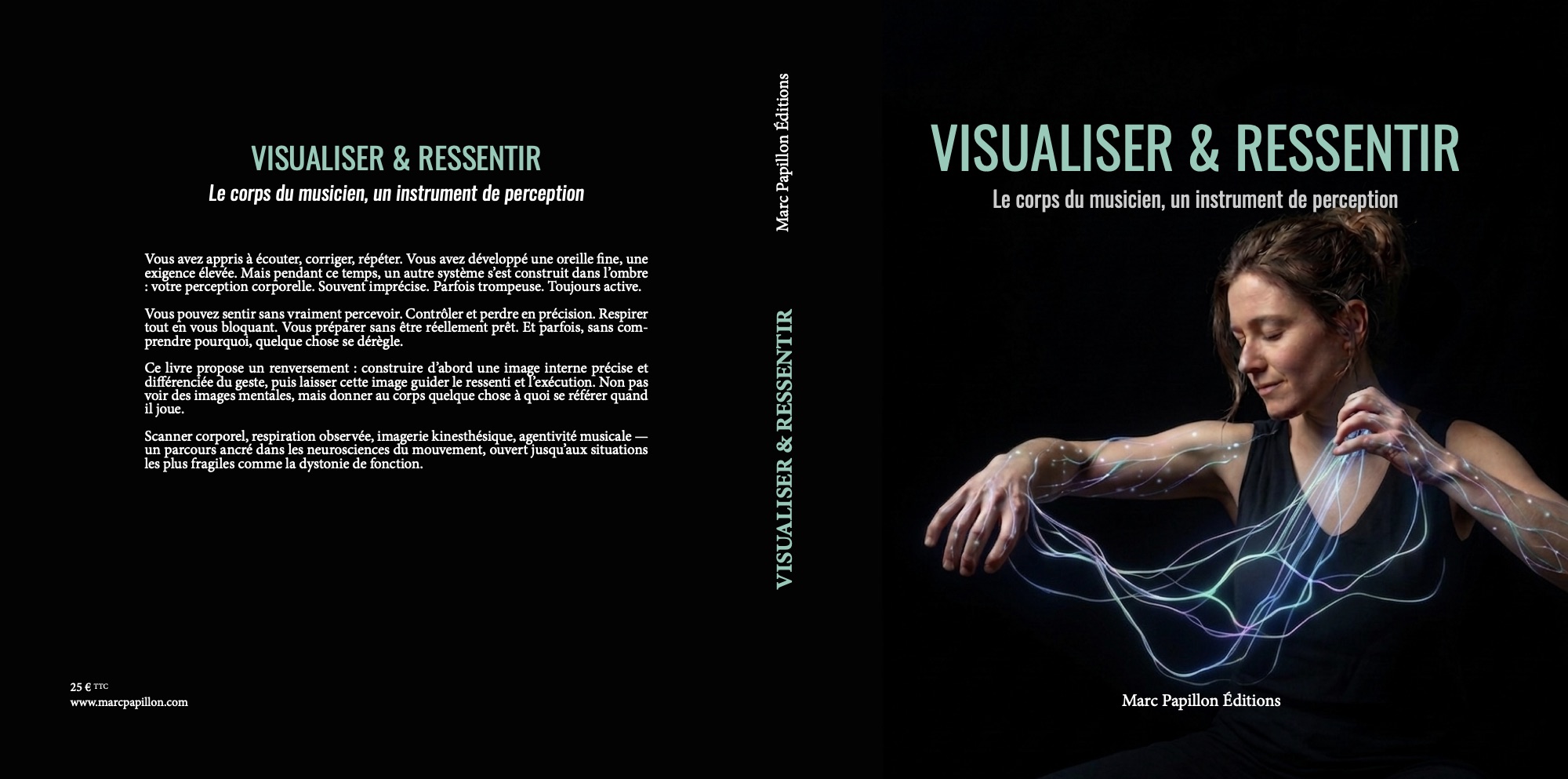
The book
Back cover
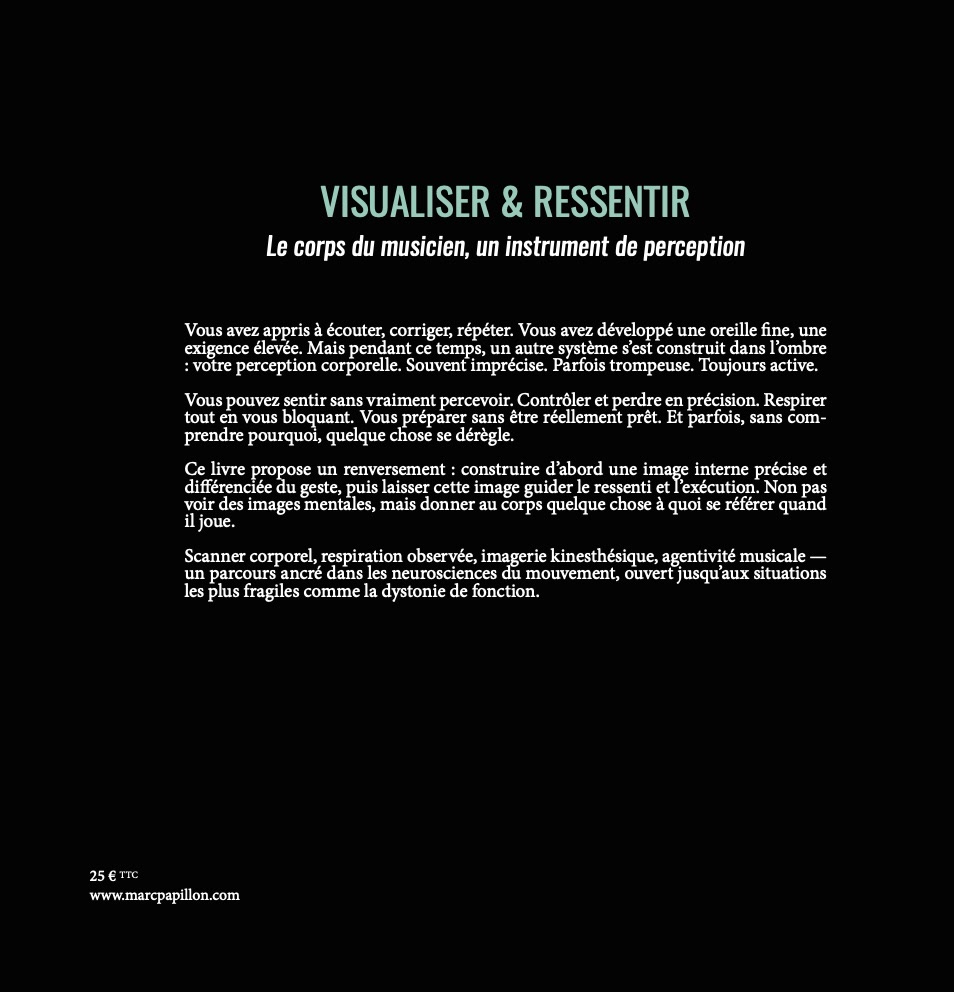
You have learned to listen, to correct, to repeat. You have developed a keen ear and high standards. But all the while, another system has been taking shape in the shadows: your bodily perception. Often imprecise. Sometimes misleading. Always active.
You can sense without truly perceiving. Control, and lose precision. Breathe while locking up. Prepare without really being ready. And sometimes, without understanding why, something goes awry.
This book proposes a reversal: first build a precise, differentiated internal image of the gesture, then let that image guide sensation and execution. Not seeing mental pictures, but giving the body something to refer to when it plays.
Body scan, observed breathing, kinesthetic imagery, musical agency: a path grounded in the neuroscience of movement and open even to the most fragile situations, such as focal dystonia.
Excerpt
Overture
You have been playing for years. You know your instrument better than your own hand, or at least that is what you believe. You know its resistances, its warm spots and its zones of sonic shadow, its whims depending on the season and the humidity of the hall. You have lived those moments when the music flows through your body without your seeming to organize it, and those other moments, far more frequent, when you work relentlessly and nothing really settles in.
Not the sound. Not the result. You: the way your pelvis rests on the chair, the weight of your hand on the string or the key, the slight compression of air in your lungs before you begin, the fine tension in your forearm that precedes the gesture without your having decided it.
Music education is extraordinarily developed on the side of the ear. This auditory refinement is real, precious, irreplaceable. But it represents only half of the perceptual system that allows you to play. The other half, proprioception, that is, your body’s capacity to perceive itself in space and in movement, has remained, for most of you, untrained, unattended, without a language.
This book starts from a simple question, one you may never have asked yourself in these terms: while you play, what do you perceive of your own body?
Overture
Contents
What you already know without knowing it
Variation I
The scan: listening to yourself from your feet to your head
1.1 Before picking up the instrument
1.2 What proprioception really means
1.3 The scan: how to do it
1.4 Shortening the scan without impoverishing it
1.5 What the scan is not
1.6 The scan as a permanent starting point
1.7 Varying the conditions in which you practice the scan
1.8 What musicians notice first
Variation II
Breathing as a sense
2.1 What breathing does without being asked
2.2 Breathing as a regulator of perception
2.3 Bringing breathing into the scan
2.4 Breathing and the right muscle tone
2.5 Breathing and presence in the moment
2.6 A few practical points to watch
2.7 Breathing as a link between the Variations
2.8 An integration exercise: the breathed scan
Variation III
Imagining in order to feel better
3.1 An ancient practice, a recent science
3.2 Three forms of imagery, three distinct uses
3.3 What auditory imagery protects
3.4 The power of kinesthetic imagery
3.5 How to practice kinesthetic imagery
3.6 Imagery in daily practice
3.7 Visualizing in order to feel, not the other way around
3.8 Auditory imagery and kinesthetic imagery: learning to tell them apart
3.9 An integration exercise: guided mental rehearsal
Variation IV
What the body knows that no one taught it
4.1 Proprioception does not come automatically
4.2 What the instrument does to perception
4.3 Hypermobility, an advantage that can become a blind spot
4.4 Is intensive practice enough to build proprioception?
4.5 Learning to feel before learning to reproduce
4.6 Variability as a teaching tool
4.7 What the body already knows, and how to access it
Interlude
The unsuspected dancer
Capoeira, African dance: the musician, a dancer without knowing it.
Variation V
The body that plays with sound
5.1 When the gesture produces the sound, and not the other way around
5.2 Musical agency: a key notion
5.3 What a research experiment reveals
5.4 Proprioception at the heart of agency
5.5 When the body disappears behind the instrument
5.6 Regaining agency in everyday practice
5.7 The right movement, neither too much nor too little
Variation VI
When the brain detects the error before the finger
6.1 A counterintuitive discovery
6.2 Pre-error slowing, what the body knows before the hand
6.3 Pre-error negativity, a brain signal before the gesture
6.4 Monitoring without auditory feedback
6.5 What this changes for practice
6.6 When monitoring turns into hypervigilance
6.7 Trusting the system, trust as a skill
Variation VII
When the sense of gesture goes awry. Proprioception and focal dystonia
7.1 A disorder that is sensory first
7.2 What dystonia is not
7.3 The cortical map that loses its boundaries
7.4 When sensory tricks bring relief, and what they reveal
7.5 Motor overload as fertile ground
7.6 What fifteen minutes of proprioceptive stimulation can do
7.7 Retraining through proprioception: principles and directions
7.8 What the previous Variations prepare
Coda
The musician’s body is not the instrument of music. It is its source. Everything begins there.
Order the book
Visualize & Feel
A 121-page book.
French edition · Marc Papillon Éditions – 2026