Anatomy of the Musician · Technique and Performance
Drums and Percussion
Illustrated book, 230 pages.
Marc Papillon Éditions – 2021
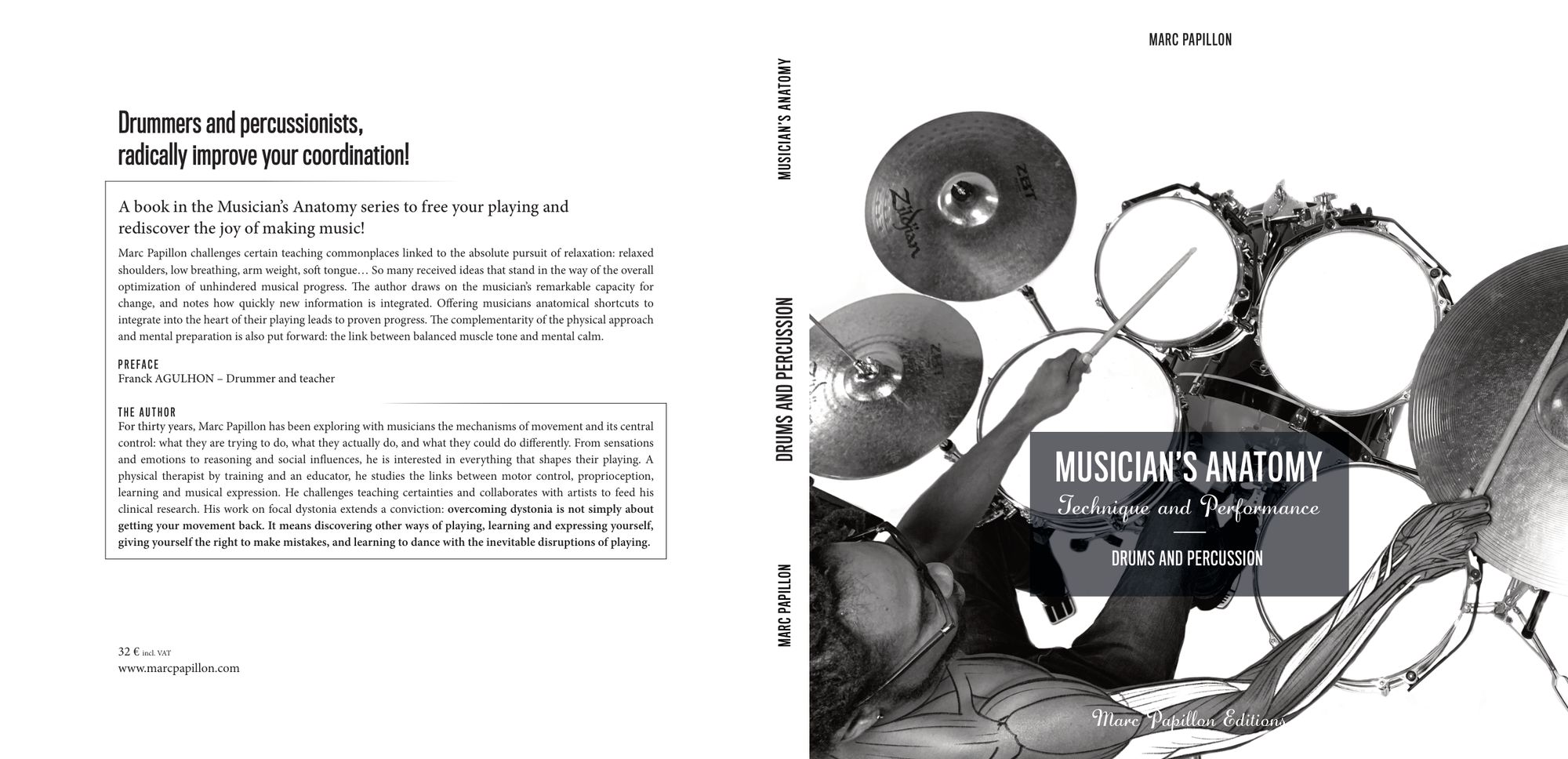
The book
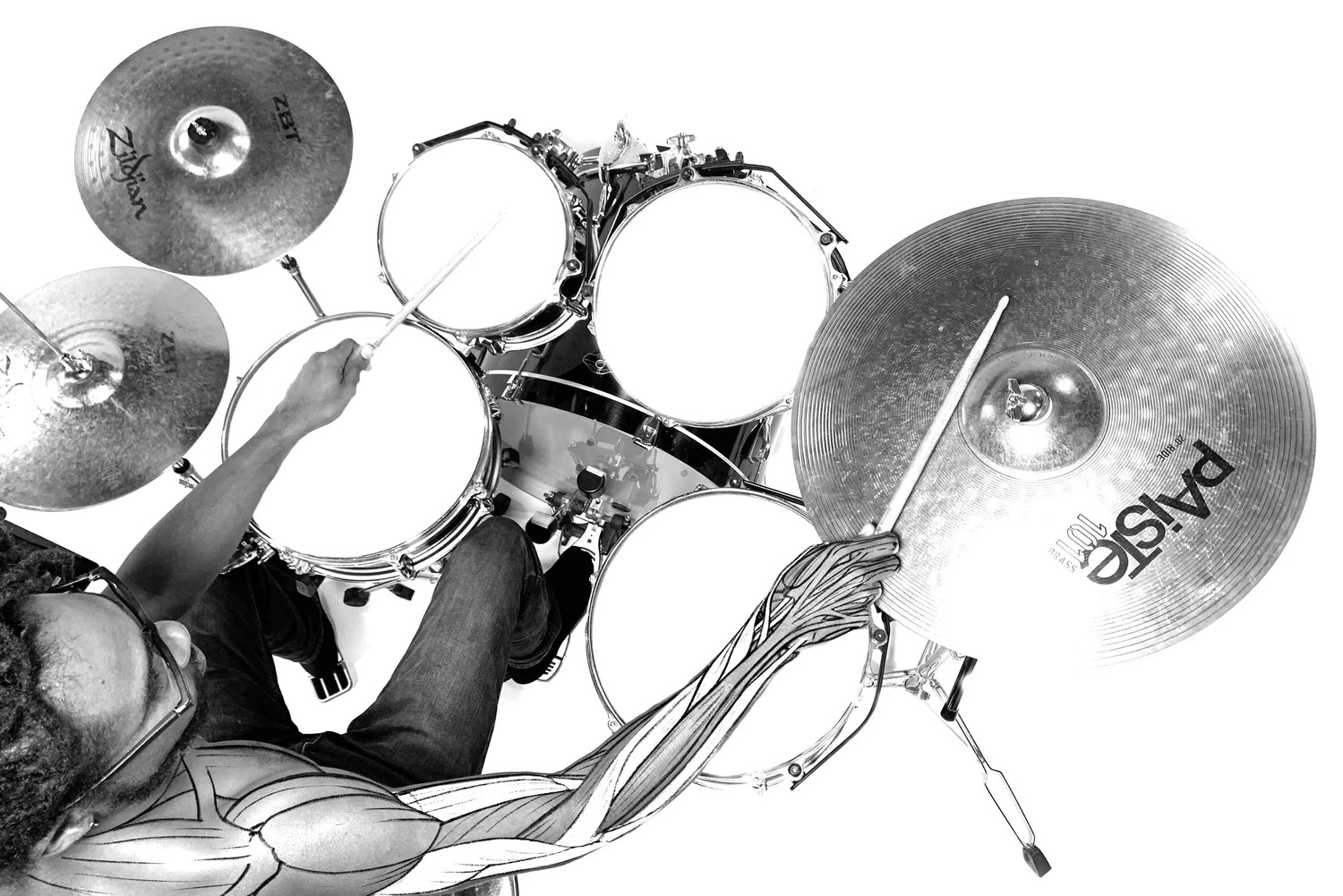
It all starts with an idea. Perhaps you want to join an orchestra. Perhaps you want to take your playing to a whole new level.
Visualize and feel more clearly

Functional anatomy at the heart of your technique, in the service of music!
Foreword by Franck Agulhon
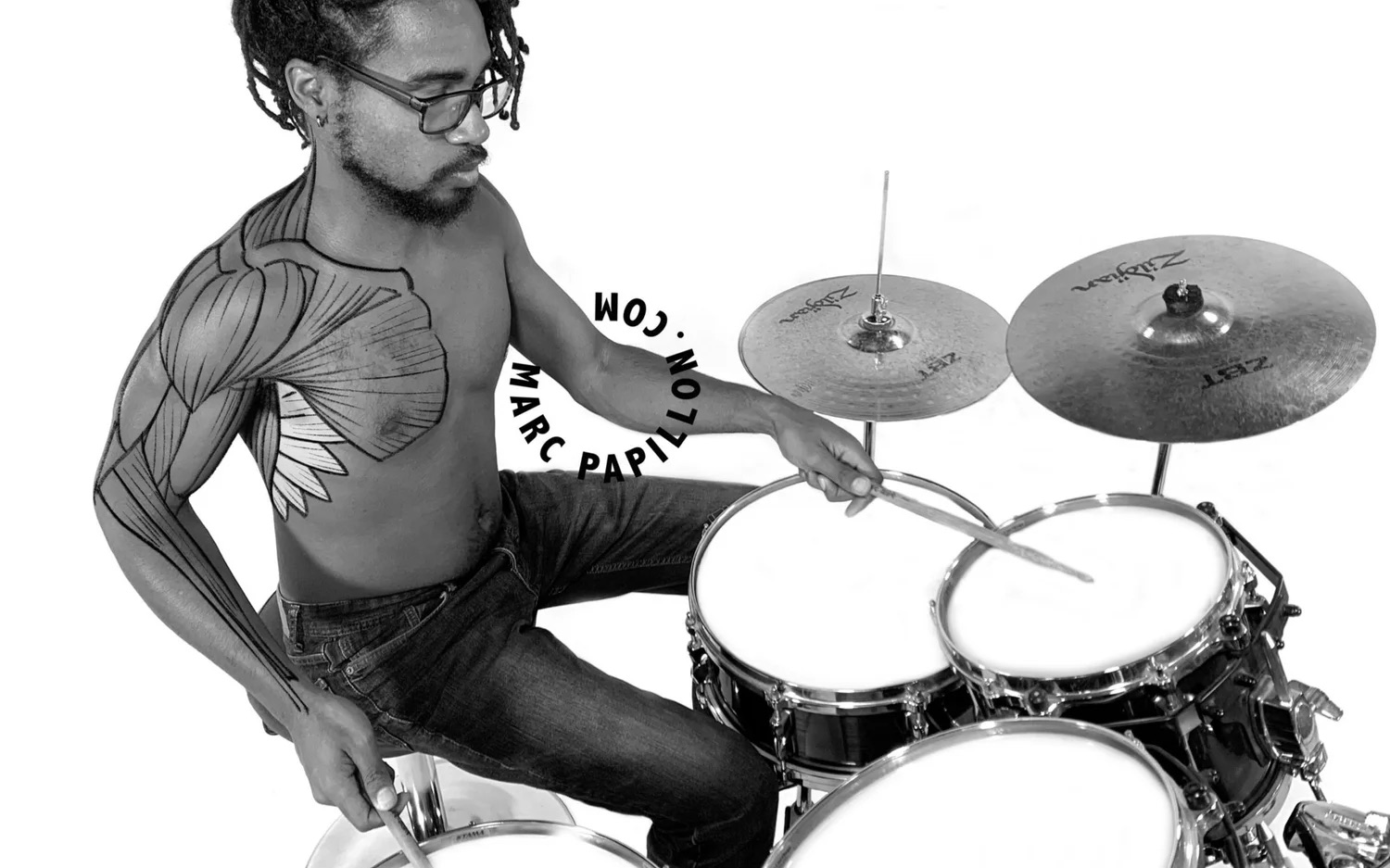
In a musician’s daily practice, the body is a tool in the service of musical expression.
It carries the artist’s musical choices and intentions. It is the primary link between their thoughts and the sounds that result at the end of the process.
This link can be disrupted by various tensions, both mental and muscular.
Achieving the “perfect” movement requires a subtle match between mind and body.
In other words, a perfect symbiosis between perception, intention and execution.
Learning an instrument takes a long time, so that playing becomes fluid and expressive.
The musician’s ear analyzes the present moment and sends the information to the brain, which then “commands” the limbs involved in the instrumental movement.
From this movement, sound is born. From this sound, and from those that precede or follow it, music is born.
Many parameters are involved in this phenomenon:
Breathing – Stress – Mental preparation – Functional physiology – Physical abilities – Muscular sensations – Tension – Ergonomics – Position at the instrument…
Having superbly explored and explained all these phenomena for other families of instruments, Marc Papillon turns in this book to drummers and percussionists.
Depending on the musical style or the context, the drummer’s “role” can vary greatly.
The power required, finesse of phrasing, rhythmic precision, independence and coordination are drumming skills that all demand great control of the body.
What is more, the drum kit is an instrument that involves all four limbs.
For a drummer, the choreography of ease defined by Xavier Gagnepain depends on a great many parameters.
Sitting on the stool and its height – Holding the sticks – Setting up the drums and cymbals – Controlling breathing and stress – The position of the back – Using the wrists, forearms, arms and shoulders together – Releasing after each stroke – The position of the feet on the pedals – The ankles…
All these parameters are of course related to each drummer’s build.
So it seems essential to me to know one’s body and the different muscle groups involved in drumming.
Without any dogmatism, Marc Papillon sets out in this book to help us better understand and better perceive the physical challenges, so that everyone can avoid the conditions all too often associated with intensive drumming: various forms of tendinitis, back pain, neck pain, low back pain…
The clarity of the explanations and the relevance of the illustrations will, I am sure, enable everyone to free themselves from all tension, and also to improve both their speed and their musicality, by balancing this incredible equation that links movement to music.
Franck Agulhon – Drummer and teacher
Foreword by Laurent Bataille

“Float like a butterfly, sting like a bee”
This line from Muhammad Ali, which the great Roy Haynes himself decoded for me, drawing, like Miles Davis, an analogy between the drummer and the boxer, often comes back in my teaching, or when I try to explain swing or groove on the drums to students of all ages and levels: “Float like a butterfly, sting like a bee!”
“Float like a butterfly, sting like a bee!” To me, at least, this partly expresses what drummers should aim for, ideally with a real awareness of how to use their body optimally. Feeling rhythm is one thing; translating that feeling is another. At the end of a long apprenticeship, the drummer, the true heart of the band, should in my view embody a supple and dynamic whole, combining lightness or power with a solid foundation, calm with energy, precision with speed, all without ever forgetting the music they accompany or create… So the day a Papillon (French for butterfly) knocked at my door, recommended by a former trainee I had mentored for the State teaching diploma, who had watched how I work with students, it was certainly no coincidence! Or perhaps it was? But Marc Butterfly, who will forgive me for playing on his surname, did not come only to ask me to write a foreword for his latest book. Without any proselytizing, though he shares his explorations with obvious passion (in particular his work on preventing dystonia), he took the time to explain the ins and outs of his work and of his approach, which he sees above all as physiologically preventive. Over the course of our meeting, he made me aware, among other things, of the importance of certain terms, and showed me how badly chosen or misused words could lead to real harm.
Asking a student to “relax” their shoulders, or talking about a “loose” wrist, expressions that many teachers use every day, does indeed seem absurd as a way of describing what in reality must be consciously controlled and “held”, the very opposite of what might be understood as “let go” or “floppy”.
It is only one example, but if a single 30-minute meeting was enough for me to realize how used my tendons were to holding my wrist (because that is their role, as the many illustrated plates in the book you are holding clearly show), imagine how much this book can help those looking for answers and a method to better master their breathing, their muscle memory or the ergonomics of their position, by allowing the right neural information to flow for every movement or micro-movement needed in drumming, whether subtle and soft or, on the contrary, energetic and sustained.
As in classical dance, drummers who, on their drum stool, manage movements that respect a physiology of movement originating from the shoulders or the pelvis will prevent potential conditions. We have many examples of very famous drummers whose “twisted” position or visibly stiff movements may well lead to future pain. I have noticed that female drummers, on the other hand, were often well positioned on their pelvis and generally showed less stiffness.
In any case, for each of us, the right information for a supported core and a controlled movement will avoid unnecessary tension (some tension being useful, but only very briefly) and will optimize the work needed to move the limbs around, while making phrasing, coordination or the desired volume flow more easily. This book, devoted to each important part of our body (in images with explanatory text), an anatomy that drumming often calls on in a coordinated way, will no doubt sharpen everyone’s vision and, as it did for me, bring about a saving awareness, whatever the reader’s level.
All my gratitude to Marc Papillon for this thoughtful work, which will undoubtedly benefit many, and many thanks for trusting me with this second foreword.
Laurent Bataille – Drummer and teacher
Order the book
Anatomy of the Musician
Illustrated book, 230 pages.
Marc Papillon Éditions – 2021