Anatomy of the Musician · Technique and Performance
Guitars, Basses, Lutes, Ukuleles, Mandolins, Ouds, Banjos, Sitars and Balalaikas
Illustrated book, 236 pages.
Marc Papillon Éditions – 2022
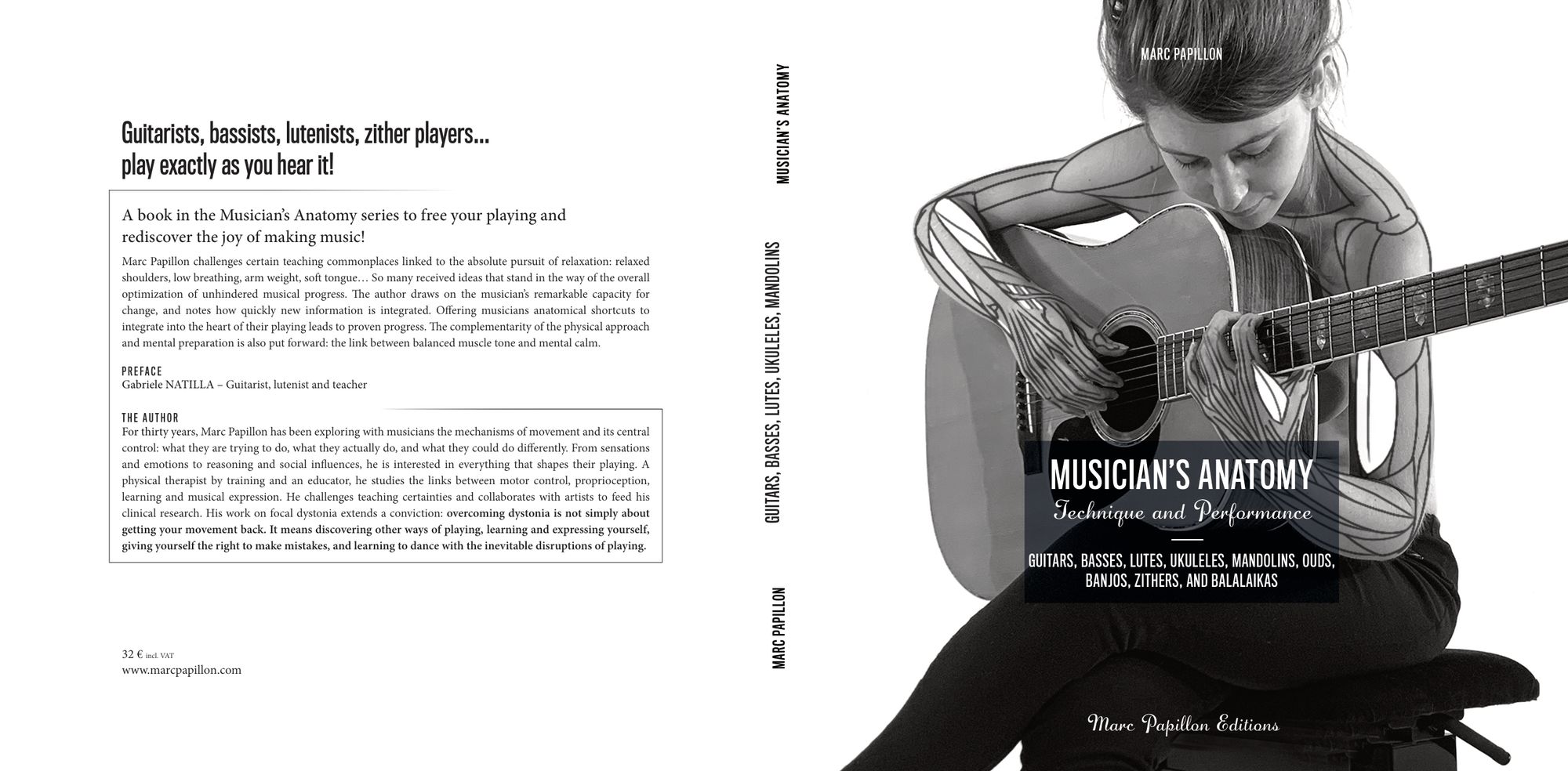
The book
It all starts with an idea. Perhaps you want to join an existing band or start a new ensemble? Perhaps you want to take your playing to a whole new level?
Take a fresh look at each of the systems involved, so that you can then use them together with ease:
Visualize and feel more clearly
Functional anatomy at the heart of your technique, in the service of music!
Foreword by Gabriele Natilla
Guitarist, lutenist and teacher.
There is no denying it: questioning oneself is a privilege in itself.
The privilege of being able to follow different paths to reach a goal. The privilege of adjusting that goal in light of new needs and new insights. I feel privileged to do this job, or more precisely the jobs of music. For me, the main ones are the stage and teaching. Periods of self-questioning have been among the most fruitful in my musical life.
I started reading the book “Anatomy of the Musician” on an ordinary day, during a break between lessons at the conservatory. I no longer saw the next student in the same way: you cannot help thinking about the information and the reflections this text offers.
Marc deserves credit for putting names to so many things whose existence we no doubt suspected. Aspects we grapple with, which we find here organized into systems, related to one another, so that we can tame them.
I grew up with the classical guitar. And no doubt the unstable, ever-evolving nature of this instrument encouraged me to broaden my interests to other instruments of the same family: early plucked strings (lutes, baroque guitar, theorbo…), not to mention the pull of new old repertoires.
Putting the physical and conceptual approach of each of these instruments into perspective is not only exciting but also beneficial. It pushes us to keep adapting our listening, our fingers, our body.
Books like “Anatomy of the Musician” remind us that a movement must remain musical. And that it can be beautiful, healthy, efficient and enjoyable all at once. And pleasure is dear to us! A musician who enjoys playing is, potentially, able to give enjoyment to others. Isn’t that one of our first goals? Far removed from performance as an end in itself or, worse, as a means of winning a competition of any kind. I like to think that each of us is, in at least one small thing, even just one, the best of all. A simple phrase in a piece, an inspired fingering, a vibrato on a single note: no one will play it as well as we do. We are all unique.
I remember the time when I was a young student at the Accademia Chigiana and the University of Siena. A very distinguished gentleman, a Scottish nobleman, came every day to attend the guitar classes within the medieval walls of the Palazzo Chigi-Saracini. One day, during the break, talking about competitions (though the same could be said of concerts or any other way of passing on one’s art), this man said something I have never forgotten: “If one must enter competitions, it is to give the very best of oneself. Going there to win would not be very kind to the others.” From this I conclude that a musician must remain a gentleman.
Gabriele Natilla, guitarist, lutenist and teacher.
Order the book
Anatomy of the Musician
Illustrated book, 236 pages.
Marc Papillon Éditions – 2022